Casket Prices in Nigeria 2026
Coffin Price List & Mortuary
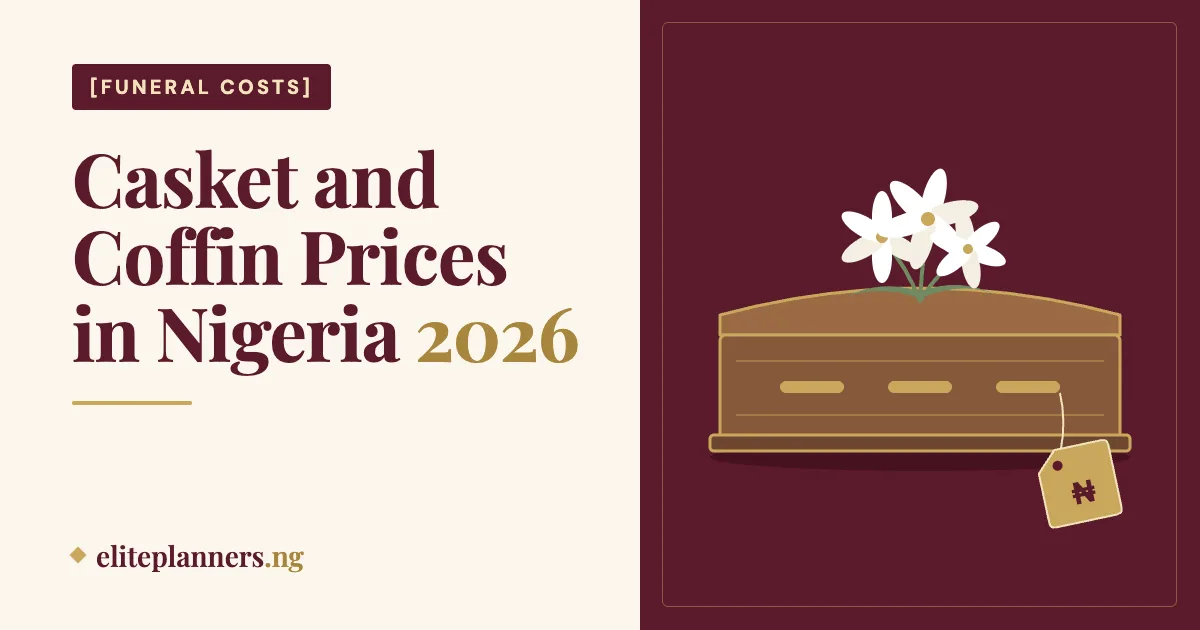
A casket in Nigeria costs about ₦150,000 to ₦300,000 for a Nigerian-made wooden one in October 2026, ₦450,000 to ₦1 million for a premium hardwood casket, and ₦1.5 million to ₦3.8 million for an imported metal one. Those are the asking prices on 22 casket listings we checked on Jiji.ng on 27 October 2026. Mortuary days are the cost most families underestimate.
If you're reading this, someone has probably just died, and a relative has handed you the job of "sorting out the casket". I'm sorry. This guide gives you the numbers, what drives them, and the questions to ask, so you can make a decent choice quickly and not be pushed into one you'll regret paying for.

How much is a casket in Nigeria in 2026?
On 27 October 2026, the 22 casket listings on Jiji.ng asked between ₦150,000 and ₦3.8 million. Ten were ₦300,000 or less, all Nigerian-made wooden caskets. Four sat between ₦450,000 and ₦800,000, mostly premium hardwood. Eight were ₦1 million or more, nearly all described as "foreign" or metallic. The middle price was about ₦500,000.
Here's how the listings broke down. We searched Jiji for "casket", kept only actual caskets and sorted them by price.
| Price band | Listings | What sellers were offering |
|---|---|---|
| ₦150,000–₦300,000 | 10 | Nigerian-made wooden caskets, often white-and-gold or plain hardwood |
| ₦450,000–₦800,000 | 4 | Customised or polished hardwood, gold-coloured handles and trim |
| ₦1 million–₦1.5 million | 2 | "Foreign-standard" caskets, including one made in Nigeria to an imported design |
| ₦2.1 million–₦3.8 million | 6 | Imported metal caskets |
A few honest caveats. These are asking prices, not what people finally paid, and most sellers expect to negotiate. Several listings were priced "per service", which can mean the price includes delivery or undertaker work, so ask what's in it. And Jiji is mostly Lagos, Port Harcourt and other big cities. A carpenter in your hometown may charge less for a plain box.
Our burial and funeral cost guide puts a modest casket at ₦80,000 to ₦250,000, a standard one at ₦250,000 to ₦800,000 and an elaborate one at ₦1 million to ₦5 million. The October listings land comfortably inside those bands.
What's the difference between a coffin and a casket?
A coffin is tapered: wide at the shoulders and narrow at the head and feet, usually six-sided. A casket is a rectangular box with four sides, often with a hinged lid that opens partway for viewing. In Nigeria people use the two words for the same thing, and most of what's sold is the casket shape.
The word "casket" first meant a box for jewellery or valuables. American undertakers adopted it for burial boxes in the mid-19th century, when the body-shaped coffin was seen as too gloomy for viewings and "casket" sounded gentler (Mental Floss explains the history).
Does the shape change the price? A little. A simple tapered coffin uses less wood and less hardware, so a local carpenter can usually make one for less than a lined casket with a split lid. If the family doesn't plan an open lying-in-state, a plain coffin is a perfectly respectable choice. Nobody at the graveside is checking the joinery.
Why do Nigerian-made and imported caskets cost so differently?
Imported caskets are mostly steel or other metal, shipped in, and priced against the dollar, so they cost several times more than a Nigerian-made wooden one. Local caskets are built from timber or board by carpenters here, with fabric lining and fittings added. Material, finish and the naira explain most of the gap.
What you're paying for, roughly in order:
- Material. Plain board or veneered wood is cheapest. Solid hardwood costs more. Metal (usually steel) is the top end, and almost all of it is imported.
- Finish and fittings. Gloss polish, carved panels, gold-coloured handles, a crest on the lid and a padded satin interior each add to the price.
- Shipping and the exchange rate. An imported casket's price follows the naira. When the naira weakens, it rises, even if nothing else has changed.
- Timing. December is peak burial season, when relatives come home from abroad. BusinessDay reported in January 2025 that demand over the season pushes funeral prices up, and that a gold-plated casket can cost ₦1.5 million or more.
My view, for what it's worth: a well-made Nigerian hardwood casket in the ₦250,000 to ₦550,000 range is the sensible middle. It looks dignified at the lying-in-state, it carries well, and it doesn't leave the family paying off a metal box that's in the ground by evening. The imported options mostly buy a look for a few hours. If that look matters to your family, fine; just make it a choice, not a default.

How much will the mortuary add, and how do you work it out?
Mortuary cost = registration or deposit + (daily rate × number of days) + embalming + release charges. Daily rates vary a lot between public hospital mortuaries and private funeral homes, and few publish them, so ask for the full tariff in writing on day one. The number of days matters more than the daily rate.
A worked example. Say the burial is set for six weeks away, which is common when relatives are travelling in or the family is raising money. If the mortuary charges ₦5,000 a day (yours could be more or less), 42 days comes to ₦210,000 before embalming and release fees. Push the burial to December and three months is ₦450,000 for storage alone. That's more than most Nigerian-made caskets cost.
Two recent stories show how this plays out:
- Enugu's mortuary tax. A state circular dated 17 September 2024 told mortuary attendants to collect ₦40 a day for any body not buried within 24 hours, to discourage long storage (TheCable, October 2024). ₦40 a day won't change anyone's plans; the mortuary's own charges will.
- Unclaimed bodies at UNTH. On 16 October 2026, the University of Nigeria Teaching Hospital in Enugu published a list of 126 unclaimed bodies, the oldest from 2008, and gave families three weeks to claim them before it seeks a court order for mass burial (Sahara Reporters). The report says families often can't afford mortuary fees, or can't be traced.
Our burial guide budgets ₦100,000 to ₦700,000 for mortuary and embalming together, depending on how long and where. If the family can agree a date sooner, that's usually the easiest saving in the whole funeral.
Do Muslim burials need a casket?
Usually not. In Islamic practice the body is washed, wrapped in a plain white shroud (the kafan) and buried directly in the ground, ideally within about 24 hours. That's why Muslim families in Nigeria rarely face casket or long mortuary costs. If a hospital, cemetery or journey home does call for a coffin, ask the imam or family elders how to handle it.
Wikipedia's overview of Islamic funeral rites summarises the washing, the shroud and the timing. The costs that remain are the shroud, the washing, transport and the grave, plus the prayers and gatherings afterwards. For a Muslim family, the casket price list matters less than how close the cemetery is and how quickly everyone can get there.
How do you buy a casket without being overcharged?
Fix your casket budget before you visit anyone, compare at least two sellers, and get every price in writing with delivery included. Ask what "per service" covers, check the casket in person, and pay a deposit rather than the full amount until it's delivered. Grief makes people agree to the first number they hear.
A short checklist to take with you:
- Measure first. Get the length and build of the deceased from the mortuary. A casket that's too small is a problem nobody wants on the burial morning.
- Ask what's included. Lining, pillow, handles, delivery to the mortuary or house, and whether the seller's men help carry it in.
- See it in daylight. Photos hide cracked veneer, loose handles and cheap lining. Press on the base. It has to carry the weight safely.
- Get two quotes. One from a funeral home, one from a carpenter or Jiji seller. The gap is often large.
- Don't let the hearse decide. Some funeral homes bundle the casket with the hearse and embalming. Bundles can be fair, but price each part separately before you accept one.
- Agree who pays. In many families the casket is one sibling's or one branch's contribution. Settle that before you order, not at the mortuary gate.
One more thing, and it's a small aside: the viral "₦50 million gold casket" videos that go round every December aren't a price guide. They're entertainment. Don't let a relative wave one at you as a benchmark.
What do the casket, mortuary and grave cost together?
The burial essentials (casket, mortuary and embalming, and the grave) cost roughly ₦330,000 to ₦800,000 for a modest funeral in 2026, ₦650,000 to ₦1.8 million for a standard one, and ₦1.8 million to ₦6.7 million or more at the elaborate end. The reception, aso-ebi and music come on top.
These ranges use the same bands as our main burial guide. The grave line splits that guide's ₦150,000 to ₦1 million range for a dug, cemented or tiled grave; cemetery plot fees, where a cemetery charges them, are extra. Treat them as a starting budget, then replace each line with your real quotes.
| Item | Modest | Standard | Elaborate |
|---|---|---|---|
| Casket | ₦80K–₦250K | ₦250K–₦800K | ₦1M–₦5M |
| Mortuary and embalming | ₦100K–₦300K | ₦150K–₦400K | ₦300K–₦700K |
| Grave (dug, cemented or tiled) | ₦150K–₦250K | ₦250K–₦600K | ₦500K–₦1M |
| Burial essentials total | ₦330K–₦800K | ₦650K–₦1.8M | ₦1.8M–₦6.7M |
Notice where the money goes once you add the rest. In our main guide the reception, canopies and catering usually cost more than everything in this table put together. So if the family has to cut somewhere, the casket line is rarely where the big savings are. Fewer mortuary days and a realistic guest count do far more.
Frequently asked questions
How much is a casket in Nigeria in 2026?
Casket listings on Jiji.ng on 27 October 2026 ranged from ₦150,000 to ₦3.8 million. Nigerian-made wooden caskets mostly cost ₦150,000 to ₦300,000, premium hardwood ₦450,000 to ₦1 million, and imported metal caskets ₦1.5 million to ₦3.8 million. Prices are negotiable.
How much is a coffin in Nigeria?
A plain coffin or simple casket from a local carpenter usually costs less than a lined, polished casket. The cheapest casket listed on Jiji in October 2026 was ₦150,000, and our burial guide puts a modest casket at ₦80,000 to ₦250,000. Ask for a written quote that includes delivery.
How much is the mortuary fee per day in Nigeria?
It depends on the facility. Public hospital mortuaries and private funeral homes set their own rates, and few publish them. Ask for the full tariff in writing, then multiply the daily rate by the days until burial and add embalming and release fees. Our burial guide budgets ₦100,000 to ₦700,000 in total.
Why are imported caskets so expensive in Nigeria?
They're mostly metal, shipped from abroad and priced against the dollar, so a weaker naira raises their price. Shipping and finish add more. On Jiji in October 2026, imported metal caskets were listed at ₦2.1 million to ₦3.8 million, against ₦150,000 to ₦300,000 for most Nigerian-made wooden ones.
Do Muslims use caskets in Nigeria?
Usually not. In Islamic practice the body is wrapped in a white shroud and buried directly in the ground, ideally within about 24 hours. That keeps casket and long mortuary costs off most Muslim funeral budgets.
For the full picture, read our burial and funeral cost guide. If you're organising the reception, the canopy, chairs and tables rental prices and the party food and drink quantity guide will help you plan seating and catering, and the aso-ebi cost guide covers family uniforms.
Estimate your budget with the free cost calculator, or browse all planning guides.