How Much Is Sadaki in Nigeria? 2026 Minimum in Naira
The minimum sadaki in Nigeria is about ₦183,000 right now, if you use the gold measure Nigerian Muslim bodies publish. The National Moonsighting Committee's post of 30 October 2026 puts the quarter dinar at ₦183,001. There's no maximum, the amount changes every week with gold and the dollar, and real couples often agree on something quite different.
That last part matters. A number like ₦230,000 on social media can frighten a groom, and some families have never heard of a minimum at all. This guide shows where the figure comes from so you can check it yourself on the day you need it. We plan events, we aren't scholars, so treat what follows as the arithmetic and the reported facts, and take the religious ruling for your own nikkai to your imam.
What is the minimum sadaki in Nigeria today?
On the gold measure, it's ₦183,001, going by the National Moonsighting Committee's post of 30 October 2026. That's the value of a quarter of a gold dinar (rubu'in dinari), the floor set by the Maliki school, which most Nigerian Muslims follow. The committee updates the number on Fridays, so expect a different figure next week.
Here's how it has moved over the past year, taken from the committee's own posts:
| Date | Minimum sadaki (quarter dinar) | Zakat nisab, same post |
|---|---|---|
| 3 Oct 2025 | ₦191,968 | ₦15,357,440 |
| 13 Feb 2026 | ₦230,250 | ₦18,420,000 |
| 5 Jun 2026 | ₦206,862 | ₦16,548,960 |
| 14 Aug 2026 | ₦201,431 | ₦16,114,480 |
| 2 Oct 2026 | ₦190,259 | ₦15,220,720 |
| 16 Oct 2026 | ₦189,707 | ₦15,176,560 |
| 30 Oct 2026 | ₦183,001 | ₦14,640,080 |
So a groom planning his nikkai in February and a groom planning his in October were looking at figures ₦47,249 apart, a drop of about 20%, without anything changing in the religion. Only gold and the naira moved.
A small oddity if you go looking: the committee lists this number as "Dowry/Theft", because the same quarter dinar is also the threshold for the theft penalty in classical Islamic law. It's a slightly alarming thing to read while planning a wedding. Since 9 October its posts have shortened the label to "Theft", but the sum hasn't changed.
How is the ₦183,000 figure worked out?
Take the gold price per gram in naira and multiply by 1.0625. That's the weight of a quarter dinar, since a dinar is 4.25 grams. On 2 November 2026 one gold tracker listed 24-carat gold at ₦168,671 a gram, which gives about ₦179,200. The committee's figure runs slightly higher because it uses its own gold price.
The sum, so you can redo it on your own date:
Minimum sadaki = gold price per gram × 1.0625 ₦168,671 × 1.0625 = ₦179,213
The posts themselves don't explain the method, so I checked it against the numbers. Every post I read has the same pattern: the sadaki figure is exactly one-eightieth of the zakat nisab. That fits, because the nisab is 20 dinars, or 85 grams of gold, and 20 dinars make 80 quarters. On 30 October the nisab of ₦14,640,080 implies a gold price of about ₦172,236 a gram, around 2% above the ₦168,407 tracker price for the same day.
Two reasons your number may not match anyone else's:
- Gold prices differ by source. Trackers show the global spot price converted to naira. Nairametrics reported ₦178,000 a gram on 14 October and said sellers in Lagos, Kano and Abuja usually charge 5%–10% above spot.
- Actually buying the gold costs more. At that premium, 1.0625 grams bought from a dealer on 2 November would run about ₦188,000–₦197,000. If your family pays sadaki in cash, the published figure is the one that counts. If they want real gold, price it at the shop.
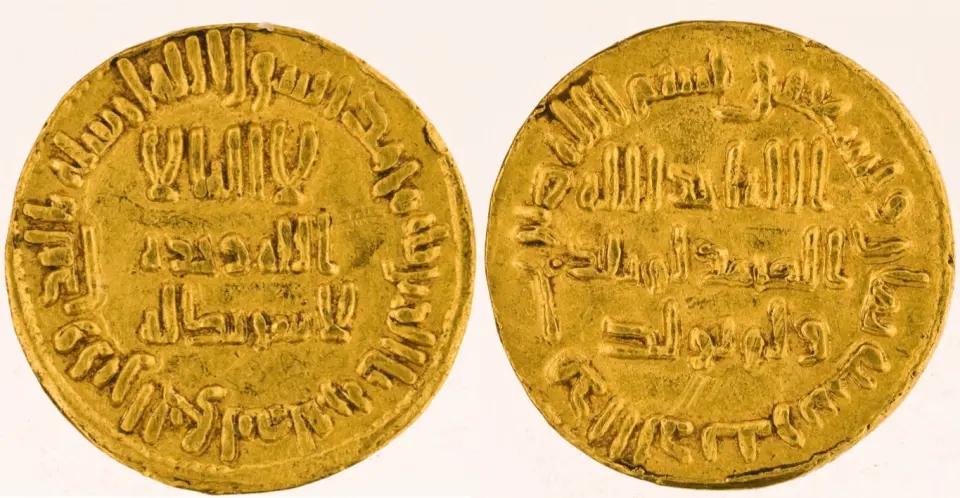
Gold dinar of Sulayman ibn Abd al-Malik, Damascus, 716–717. Photo: Wikimedia Commons, CC0.
Why has the minimum sadaki jumped so much since 2021?
The rule hasn't changed; the naira has. The Society for the Propagation of Islam put the quarter dinar at ₦23,905 in August 2021, against ₦183,001 now, more than seven times as much. Most of the jump came after the naira was floated in 2023, and gold's own climb in dollars added to it.
| When | Quarter dinar | Who published it |
|---|---|---|
| August 2021 | ₦23,905 | Society for the Propagation of Islam |
| July 2022 | ₦26,015 | Society for the Propagation of Islam |
| July 2023 | ₦28,523 | Society for the Propagation of Islam |
| July 2024 | ₦98,261 | Society for the Propagation of Islam |
| October 2025 | ₦191,968 | National Moonsighting Committee |
| October 2026 | ₦183,001 | National Moonsighting Committee |
These come from two different bodies, so don't read small differences as meaningful. The direction is the point. Wages haven't moved like this, which is why the subject gets heated: one post on X in February asked how a man earning under ₦100,000 could be expected to find ₦230,000, and that frustration is real.
Does the sadaki have to match the gold figure?
Not in every school, and the gap is huge. The Maliki floor is written as a quarter dinar of gold or three dirhams of silver. Those were equal when the rule was set, but three dirhams of silver is worth about ₦20,000 today. Hanafi scholars set ten dirhams, and Shafi'i scholars set no fixed floor at all.
| School | Stated minimum | In naira, 2 Nov 2026 (our sum) |
|---|---|---|
| Maliki, gold | Quarter dinar (1.0625g gold) | About ₦179,000–₦183,000 |
| Maliki, silver | 3 dirhams (about 9g silver) | About ₦19,300–₦19,900 |
| Hanafi | 10 dirhams (about 30g silver) | About ₦64,000–₦66,000 |
| Shafi'i | No fixed amount; anything with value | Whatever is agreed |
The schools' positions come from Mughniyya's comparative study of marriage law and a Maliki text commentary. The silver sums use ₦2,166 a gram from the same tracker and dirham weights of 2.975g–3.06g, because sources disagree slightly.
Which measure your family should use isn't something a planning site can settle. The figures Nigerian bodies publish are the gold ones. Maliki rules are also what generally applies in Muslim personal status matters in Nigeria. If ₦183,000 really is beyond you, that's exactly the conversation to have with your imam, and it's better had before the families sit down than at the Fatiha.
The hadith people usually quote here is the man told to marry "even with an iron ring", which is why many feel a modest sadaki is closer to the spirit of things than a large one. Scholars read that narration in different ways, too. Ask.
How much do Nigerian couples actually pay as sadaki?
There's no national survey, so nobody can give you a true average. The figures on public record range from ₦20,000 to ₦220,000, and our own estimated range for a family nikkai is ₦50,000–₦500,000. Payment follows what the two families agree, and the published minimum is only one of the things they weigh.
The few real numbers we could find:
| Case | Sadaki or dowry reported | Source |
|---|---|---|
| Sokoto state mass wedding, January 2014 | ₦20,000 per bride | P.M. News |
| Kano state mass wedding, 1,500 couples, August 2026 | ₦100,000 per couple, plus a ₦100,000 business grant | Tribune |
| Kaduna Sharia court, September 2026 | ₦120,000 agreed and unpaid | Gazette |
| Kaduna Sharia court, October 2026 | ₦220,000 paid before the marriage was called off | The Whistler |
The Kano line is the telling one. The state's ₦100,000 dowry was about half the committee's gold figure that month (₦201,431 on 14 August). Some outlets reported ₦200,000 as dowry, though the governor's own words and Tribune's report split it into dowry and capital. Either way, a state programme run with its Hisbah board wasn't tied to the weekly number.
Our ₦50,000–₦500,000 range, used in the Nikkai cost guide, is an estimate rather than measured data. Treat it that way.
Who keeps the sadaki, and when must it be paid?
The bride keeps it. It's hers, not her father's or her family's, and the Qur'an tells husbands to give women their dowries graciously. It can be paid at the nikkai or at a known later date, but a Kaduna Sharia court judge said in 2026 that it should be paid without delay.
That Kaduna case is worth reading if you're tempted to defer. A divorced woman took her former husband to court over ₦120,000 of agreed dowry he'd never paid, and the judge ordered him to pay by a fixed date. An unpaid sadaki doesn't go away because the marriage did.
What the sources say on the awkward questions:
- Paying later: the schools accept deferral to a known date. Malikis reject open-ended deferral "till death or divorce", so name the date.
- Divorce before the marriage is consummated: if a sadaki was fixed, the husband owes half, based on Qur'an 2:237.
- Divorce by the husband (talaq): the wife doesn't return her sadaki.
- Divorce she asks for (khul'): she pays compensation, and in Babajo v Dontsho the Shari'ah Court of Appeal held that the most she should pay is the amount of the sadaki. Both points come from the Musawah overview of Nigerian Muslim family law.
That same overview makes a point I think families should hear: women's right to negotiate their sadaki is often played down, and many are persuaded it's more spiritual to ask for little or nothing. A low sadaki chosen freely by the bride is lovely. One chosen for her isn't the same thing. She should be in that conversation, even if only through her wali.
How should a couple decide the sadaki amount?
Agree the number early, with the bride's say included, and treat it as a budget line, not a price. Check the current quarter-dinar figure, ask your imam which measure applies, then fix an amount the groom can pay in full. In practice the sadaki is often a small slice of the whole Nikkai bill.
A sensible order:
- Check the figure that week. The committee posts on X at @moonsightingng, or use the formula above with a dated gold price.
- Ask your imam which measure he uses. Do this before the families meet, so that nobody is surprised at the table.
- Let the bride state what she wants. It's her property. If she wants to set it low, or forgive part of it later, that's her right, and the verse linked above covers that too.
- Write the amount down. Note whether it's paid at the Fatiha or by a stated date. The Kaduna cases above both turned on what had been agreed and what had been paid.
- Budget it apart from kayan lefe. Sadaki is the religious obligation; lefe, kayan daki and the walima are custom. The Nikkai guide and our traditional marriage list price those separately.
My honest view: if money is tight, shrink the walima before you shrink the sadaki. A ₦183,000 sadaki goes to your wife and stays hers. The same money on extra coolers of food is gone by Maghrib. Our guide to making a wedding budget can show you where that room is.
Frequently asked questions
How much is sadaki in Nigeria today?
On the gold measure, about ₦183,000, based on the National Moonsighting Committee's figure of ₦183,001 on 30 October 2026. It changes weekly. To work it out for any date, multiply the naira price of a gram of gold by 1.0625. There's no maximum; families agree the actual amount themselves.
Can sadaki be less than the minimum?
Under the Maliki gold measure, a quarter dinar is the floor. The same school also states it as three dirhams of silver, worth about ₦20,000 today, and other schools set lower floors or none. Which applies to you is a question for your imam, not a planning site.
Can sadaki be paid in instalments?
It can be deferred to a known date, so paying part now and the balance on a stated date is worth raising with your imam. Malikis don't accept open-ended deferral "till death or divorce". Write down the amounts and dates, because Nigerian Sharia courts have ordered unpaid sadaki to be paid after a divorce.
Is sadaki the same as bride price?
No. Sadaki goes to the bride and belongs to her, while a bride price in many Nigerian customary marriages goes to her family. News reports often call sadaki "dowry", which adds to the confusion. Our traditional marriage list guide sets out what each ethnic group pays.
Does a wife return the sadaki after divorce?
Usually not when the husband ends the marriage by talaq. In khul', where she seeks the divorce, she pays compensation, and a Nigerian Shari'ah Court of Appeal held that it shouldn't exceed the sadaki. If the divorce comes before consummation, the husband owes half of the fixed amount.
Sorting out the rest of the day? Start with the full Nikkai and Fatiha cost guide, then check the Hausa list in our wedding checklist so nothing gets missed.
Estimate your budget with the free cost calculator, or browse all planning guides.