Which Finger Is for the Wedding Ring? Nigerian Customs
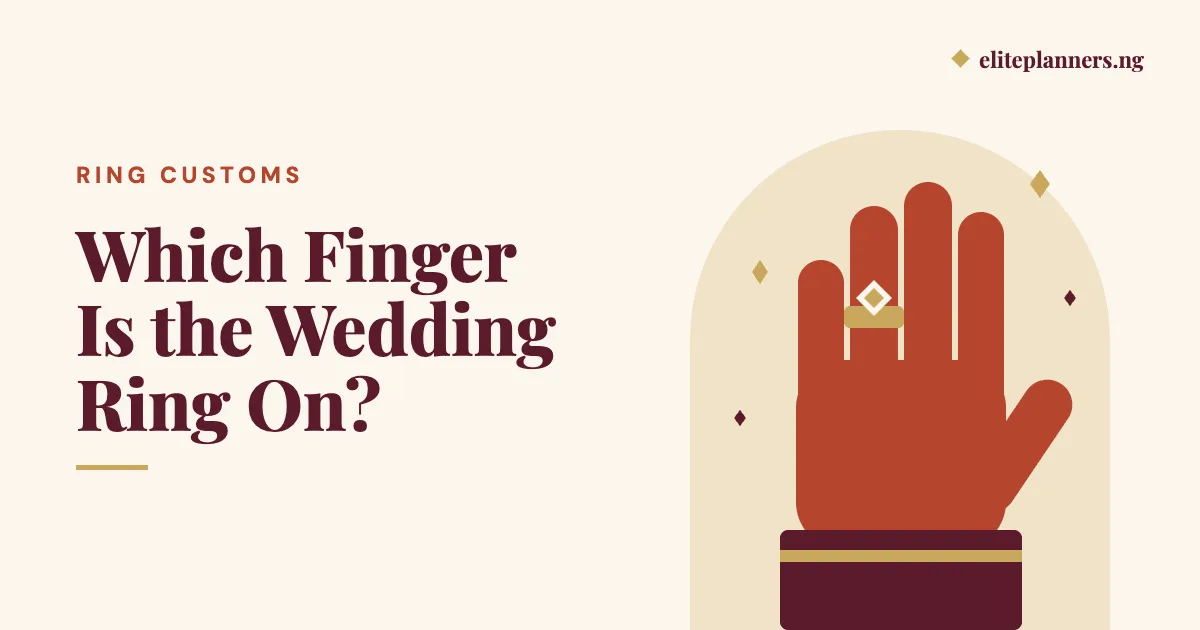
In Nigeria, the wedding ring is worn on the fourth finger of the left hand, the one between the middle finger and the little finger. Most couples wear the engagement ring on the same finger and slide the wedding band on below it, closest to the hand. Some couples, and some faiths and countries, use the right hand instead, and that's fine too.
So that's the short answer. The longer one involves a Roman myth, a few religious differences, and the very Nigerian question of what happens to the ring between the traditional wedding and the white wedding.

Which finger is the wedding ring worn on in Nigeria?
Most Nigerian couples wear the wedding ring on the left hand's fourth finger, usually called the ring finger. This largely follows the British church tradition that arrived with Christian and registry weddings. Men and women both use the same finger, and there's no legal rule about it.
The ring finger is counted from the thumb: thumb, index, middle, ring, little. If you're left-handed and the ring keeps knocking against things, you can wear it on the right. Nobody at the registry will stop you.
Why is the wedding ring worn on the left fourth finger?
The popular explanation is the "vena amoris", an old belief that a vein ran straight from the left ring finger to the heart. It's a lovely story, but it isn't true anatomically: every finger has similar veins, and none connects directly to the heart. The custom is old; the reason is mostly romance.
The idea is usually traced to ancient Rome, with some writers pointing to Egypt instead, and historians don't fully agree. The Latin name "vena amoris" was popularised much later, in a 17th-century English legal treatise on marriage. A more practical reason people give today is simply that most people are right-handed, so the left hand protects the ring from wear.
Fact-checkers including Africa Check have looked at the vein claim and found nothing to support it. So tell the story at the reception if you like. Just don't put it in a biology exam.
Should the engagement ring or wedding band go on first?
The common convention is wedding band first, closest to the hand, with the engagement ring on top. Many brides move the engagement ring to the right hand on the wedding day so the groom can slide the band straight on, then return the engagement ring above it afterwards.
It's a convention, not a rule. Some brides wear only the band day to day and keep the engagement ring for outings. Others have the two rings soldered together after the wedding so they don't twist. If the stone on your engagement ring is large, ask your jeweller whether a curved or notched band will sit better against it.
The order of the day itself, in most Nigerian church and court weddings:
- Before the ceremony, the bride moves the engagement ring to her right hand.
- During the vows, the couple exchange bands on the left ring finger.
- After the ceremony, the engagement ring goes back on the left, above the band.
Do some cultures and faiths wear the wedding ring on the right hand?
Yes. In several countries, including Germany, Norway, Poland, Russia and India, the right hand is common, and many Orthodox Christians wear it on the right. In Islam, a ring isn't required for a valid nikkah, and Muslim men are generally advised not to wear gold.
For Nigerian Muslim couples, the mahr (the bride's dowry) and the consent of both parties matter for the marriage, not the ring. Plenty of couples still exchange rings, though. The common practice is that men wear silver or another non-gold metal, since many scholars hold that gold is forbidden for men. If you want a specific ruling for your family, ask your imam.
Traditional marriages are their own thing. Rings weren't historically part of Yoruba, Igbo, Hausa or most other Nigerian traditional rites, which centre on the bride price, the families and the blessings. Today, though, many grooms present the engagement ring around the introduction or the traditional engagement, and some couples exchange bands at the traditional wedding itself.
What should you do with the ring after the traditional wedding but before the white wedding?
Most brides keep wearing the engagement ring on the left ring finger until the church or court wedding, then add the band during the vows. If you exchanged bands at the traditional wedding, many couples keep them on and simply reuse them, or wear them on the right hand until the white wedding.
There's no single right answer, and families do it differently. The thing to avoid is buying two sets of bands without meaning to. Decide early whether the bands belong to the traditional ceremony or the white wedding, and tell your officiating minister, because some churches bless the rings during the service.

How do you choose the right ring size, and what do wedding bands cost in 2026?
Size your finger in the evening, when it's warm and slightly swollen, and ask the jeweller for a ring sizer rather than guessing with string. Plain wedding bands cost roughly ₦50,000 to ₦250,000 each in 2026, depending on metal and whether there's a stone.
A few sizing tips that save a resize later:
- Measure twice, on different days. Lagos heat and air conditioning change finger size more than people expect.
- Wide bands fit tighter. Jewellers often suggest going up half a size for a band wider than about 6mm.
- Check over the knuckle. The ring should slide over with a little resistance and not spin freely.
- Ask about resizing. Most gold bands can be resized; some patterned or stone-set bands can't.
Prices below reuse our engagement ring price guide. They're rough 2026 ranges, so confirm with written quotes and get a receipt stating the gold karat.
| Band type | Typical 2026 price (each) |
|---|---|
| Silver or basic band | ₦50K–₦150K |
| Gold band, plain or with cubic zirconia | ₦80K–₦250K |
| Gold band with moissanite | ₦150K–₦500K |
| Diamond-set band | ₦500K–₦1.5M |
My opinion: for the groom's band, plain gold or silver almost always beats anything with stones. He'll wear it to work, to the gym and under a generator's worth of grease. Keep it simple and spend the difference elsewhere.
Frequently asked questions
Which hand is the wedding ring worn on in Nigeria?
The left hand, on the fourth finger, for most Nigerian couples. Some people wear it on the right for comfort, religion or family custom, and there's no law about it.
Can a man wear his wedding ring on the right hand?
Yes. Many men, especially left-handed men or those who work with their hands, wear the band on the right. Muslim men commonly choose silver or another non-gold metal.
Is the wedding ring required for a Muslim marriage?
No. A ring isn't a requirement for a valid nikkah. The mahr and the consent of both parties are what matter, though many Nigerian Muslim couples still exchange rings as a personal choice.
Do you wear a ring after the traditional marriage in Nigeria?
Many brides wear their engagement ring from the introduction onwards. Some couples exchange bands at the traditional wedding, others wait for the church or court wedding. Agree it with your partner and families early.
How much is a wedding band in Nigeria in 2026?
A silver or basic band costs about ₦50,000 to ₦150,000, a gold band ₦80,000 to ₦250,000, and a diamond-set band ₦500,000 to ₦1.5 million. Prices move with the naira and the gold price.
Before you buy, compare prices in our engagement ring price guide, check the paperwork in church wedding requirements or the court wedding cost guide, and if you're still at the asking stage, browse our proposal ideas.
Estimate your budget with the free cost calculator, or browse all planning guides.