Wedding Colour Combinations for Nigerian Weddings 2026
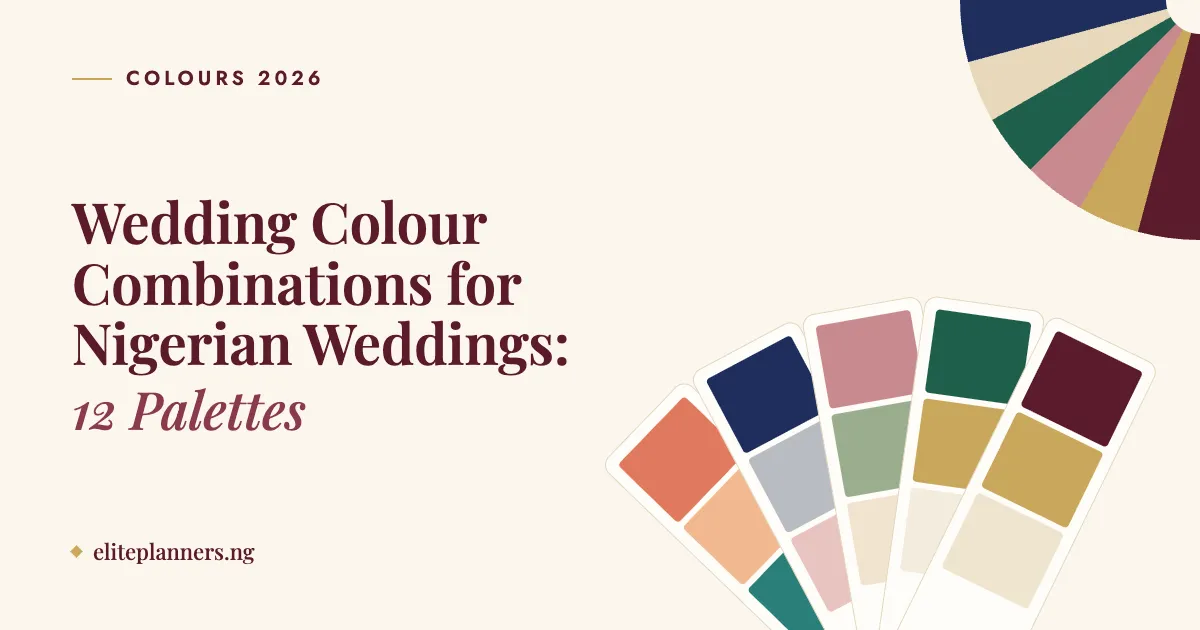
The wedding colour combinations Nigerian couples return to most are wine and gold, emerald and gold, champagne and ivory, lilac and silver, and royal blue and gold. They work because they flatter dark and light skin alike, look rich on aso-ebi, and hold up under the warm lights of a Nigerian event hall.
Your colours touch more than the décor. They decide the aso-ebi fabric hundreds of guests will buy, the IV card, the cake and the bridal train. So it's worth picking a palette that photographs well and that your aunties can actually find in the market. Here are 12 that do.
What are the most popular wedding colour combinations in Nigeria?
Rich jewel tones paired with a metallic lead Nigerian weddings: wine and gold, emerald and gold, and royal blue and gold. Softer palettes like champagne and ivory, sage and cream, and lilac and silver are popular for church weddings and garden receptions. Most couples pick one main colour, one accent, and one neutral.
Here are 12 palettes with sample hex codes you can send to your decorator, tailor and IV designer. Hex codes are only a guide; fabric dyes never match a screen exactly.
| Palette | Main | Accent | Neutral | Best for |
|---|---|---|---|---|
| Wine and gold | Wine #722F37 | Gold #C9A85C | Ivory #FFFFF0 | Evening receptions, December weddings |
| Emerald and gold | Emerald #046307 | Gold #C9A85C | Cream #FBF6EC | Traditional ceremonies, aso-oke |
| Royal blue and gold | Royal blue #1D3F9A | Gold #C9A85C | White #FFFFFF | Large halls, Yoruba and Edo weddings |
| Champagne and ivory | Champagne #F7E7CE | Ivory #FFFFF0 | Soft gold #D4AF37 | Church weddings, minimal décor |
| Lilac and silver | Lilac #C8A2C8 | Silver #C0C0C0 | White #FFFFFF | Daytime weddings, bridal trains |
| Sage and cream | Sage #9CAF88 | Cream #FBF6EC | Gold #C9A85C | Garden and outdoor weddings |
| Peach and coral | Peach #FFCBA4 | Coral #FF7F50 | Ivory #FFFFF0 | Daytime, beach and resort weddings |
| Burnt orange and brown | Burnt orange #CC5500 | Chocolate #5C3317 | Cream #FBF6EC | Traditional weddings, earthy aso-oke |
| Coral and gold (Edo) | Coral red #C0392B | Gold #C9A85C | Ivory #FFFFF0 | Edo and Delta weddings with coral beads |
| Navy and blush | Navy #1F2A44 | Blush #F4C2C2 | Silver #C0C0C0 | Modern city receptions |
| Black and gold | Black #111111 | Gold #C9A85C | White #FFFFFF | Glam evening receptions, Gatsby themes |
| Cloud white and green | Off-white #F0EEE9 | Leaf green #4F7942 | Wood brown #8B5A2B | Minimal, nature-led weddings |
The last one nods to Pantone's 2026 Colour of the Year, Cloud Dancer (PANTONE 11-4201), a soft off-white announced in December 2025. It's a lovely base, but on its own it can look washed out in a hall. Pair it with greenery or wood.

Photo: Stefan Maass on Unsplash.
How do you choose your wedding colours?
Start with the season, the venue and what you'll wear, then pick one main colour, one accent and one neutral. Check how the colours look on fabric in daylight and under warm hall lights, and make sure the aso-ebi colour flatters most of your guests. Agree it with both families before anyone buys fabric.
A five-step way to decide:
- Look at the venue first. A hall with red carpet and gold chairs will fight a lilac palette. Work with what's already there, or budget to cover it.
- Think about the time of day. Pastels glow in daylight; jewel tones look richer at night.
- Pick your main colour from the outfits. The bride's traditional attire or the aso-ebi usually sets the tone, not the napkins.
- Test on fabric. Get small swatches and look at them outside and under a yellow bulb. Some lilacs turn grey indoors.
- Get both families to agree. In many Nigerian weddings, the aso-ebi colour is a family decision. Our aso-ebi cost guide explains how the groups usually work.
A small aside: ask your photographer which colours they love shooting. They've seen hundreds of halls and will tell you, quite honestly, which palettes turn muddy in photos.
Which wedding colours suit aso-ebi?
Strong, saturated colours suit aso-ebi best: wine, emerald, royal blue, burnt orange and gold all look rich on lace and aso-oke and flatter most skin tones. Very pale colours like champagne or blush can look flat in group photos and show stains, so many couples use them for the bridal train and keep the aso-ebi bolder.
What to think about when you choose the aso-ebi shade:
- Skin tones in the family. Wine, emerald and gold suit almost everyone. Neon colours suit fewer people than you think.
- Fabric availability. Popular colours are easy to buy in lace, aso-oke and George in Lagos, Onitsha and Kano markets. An unusual shade may need dyeing, which takes time.
- Gele and cap colour. The gele often carries the accent colour; our gele types guide shows which fabrics hold colour well.
- Two tones. Many couples choose a main aso-ebi for family and a second colour for friends. It looks lovely in photos and stops arguments about who gets the "real" colour.
How many colours should a wedding have?
Three is the sweet spot: a main colour, an accent and a neutral such as ivory, cream or white. Two can look plain in a large hall; four or more starts to look busy, especially once guests arrive in aso-ebi and the décor adds flowers and lights of their own.
A useful split is roughly 60% main colour, 30% neutral and 10% accent. In practice, that means:
- Main colour: aso-ebi, table runners, the bridal train.
- Neutral: linen, chair covers, the cake.
- Accent: cutlery, chargers, gele, flowers, lighting.
Metallics like gold and silver count as accents, not as a fourth colour. Which is good news, because most Nigerian weddings will end up with gold somewhere whether you planned it or not.

Photo: Jonathan Borba on Unsplash.
Do wedding colours change the decoration cost?
Colour itself doesn't change the price much, but some choices do. Standard colours like white, gold and ivory are easy for decorators to supply from stock; unusual shades can mean buying or dyeing new linen and fabric, which adds cost. Fresh flowers in specific colours also cost more out of season.
Our wedding decoration cost guide puts a budget setup at ₦300,000–₦600,000 and a premium setup with colour-coordinated linen at ₦2 million–₦4 million in 2026. Where your palette lands in that range depends on:
- Linen and chair covers in stock. Ask your decorator which colours they already own.
- Lighting. Coloured uplighting can carry a palette for less than buying everything in that colour.
- Flowers. Artificial flowers in your exact shade are often cheaper and more reliable than fresh ones.
Get two or three decorators to quote the same written brief, with your hex codes and swatches attached, and compare like for like.
My take: choose the palette your guests can dress in without stress, and let the décor follow. A beautiful hall full of guests in the wrong shade of lilac looks worse than a simple hall where everyone got it right.
Frequently asked questions
What are the best wedding colour combinations for a Nigerian wedding?
Wine and gold, emerald and gold, royal blue and gold, champagne and ivory, and lilac and silver are the most popular. Jewel tones with gold suit evening receptions and aso-ebi; softer pastels suit church weddings and daytime garden receptions.
What is the wedding colour of the year for 2026?
Pantone named Cloud Dancer (PANTONE 11-4201), a soft off-white, as its 2026 Colour of the Year in December 2025. It works as a neutral base for a wedding palette, especially with green and wood tones, but most Nigerian weddings pair it with a stronger main colour.
How many colours should I choose for my wedding?
Choose three: a main colour, an accent and a neutral. A simple split is about 60% main colour, 30% neutral and 10% accent. Gold or silver metallics count as accents rather than an extra colour.
What colours look best in wedding photos?
Saturated colours such as wine, emerald, royal blue and burnt orange usually photograph well under hall lighting. Very pale shades can look washed out indoors and some lilacs turn grey under warm bulbs, so test fabric swatches under the venue's lights and ask your photographer.
Should the bride and groom match the aso-ebi colour?
Many couples do for the main ceremony, using the same colour family for the bride's outfit and the groom's agbada or isiagu, with families in a complementary shade. It's a tradition, not a rule, so agree it with both families early.
Planning the look? Read up on traditional outfits for brides, set your wedding budget, and see what a palette costs to dress a hall in the decoration cost guide.