Wedding Vows for Nigerian Couples
Examples to Adapt
At a Nigerian registry (court) wedding, the Marriage Act sets the words: each of you says "I call upon all persons here present to witness that I, A.B., do take thee, C.D., to be my lawful wife (or husband)." In church, the denomination's rite usually gives you the vows to repeat. A nikah and a traditional marriage have no spoken vows at all.
Personal vows, the ones you write yourselves, are optional almost everywhere. Many Nigerian couples say them at the reception, at a pre-wedding dinner or alongside the church's standard vows where the pastor allows it. Below are the set wordings, then eight examples you can adapt.
What vows do you say at a court wedding in Nigeria?
At a registry, the registrar first asks whether you've come to become husband and wife, explains that the marriage can only be ended by a court divorce and that a second marriage would be bigamy, then each of you says the declaration set out in section 27 of the Marriage Act. You can't swap it for your own words, though you can add a personal vow after.
The registrar's part, and yours, in the Act's own wording:
Do I understand that you, A.B., and you, C.D., come here for the purpose of becoming man and wife?
Then, after the warning about divorce and bigamy, each party says to the other:
I call upon all persons here present to witness that I, A.B., do take thee, C.D., to be my lawful wife (or husband).
The Act says this happens in the registrar's office, with open doors, in front of two witnesses, between 10am and 4pm. Then you, the registrar and your witnesses sign the certificate. It's short, legal and over in minutes, which is partly why so many couples add something more personal at lunch afterwards. Our court wedding guide covers the fees and paperwork.
What are the traditional church wedding vows?
Most Anglican and many other Protestant churches in Nigeria use, or adapt, the vows from the Book of Common Prayer. The groom says: "I, N., take thee, N., to my wedded wife, to have and to hold from this day forward, for better for worse, for richer for poorer, in sickness and in health, to love and to cherish, till death us do part."
The full 1662 wording continues "according to God's holy ordinance; and thereto I plight thee my troth." In that older text the bride also promises "to obey"; many modern services drop it or make the promises identical. You'll normally repeat the vows phrase by phrase after the minister, so there's nothing to memorise.
How other churches usually handle it:
| Ceremony | Who sets the vows | Can you add your own? |
|---|---|---|
| Registry (court) | The Marriage Act, section 27 | Only after the legal declaration |
| Anglican, Methodist and similar | The church's marriage service, usually based on the Book of Common Prayer | Ask the minister; often at the reception instead |
| Catholic | The Church's Rite of Marriage; you promise to be faithful in good times and bad, in sickness and health, and to love and honour each other all your lives | Generally no changes to the vows themselves |
| Pentecostal and independent churches | The pastor, often with a standard text | Often yes, alongside the standard vows |
| Nikah | No spoken vows; offer and acceptance before witnesses | Personal words fit best at the walima |
| Traditional marriage | No vows; the families' rites and the bride's acceptance | Usually at the reception |
The Marriage Act also sets the church side: a licensed church wedding must happen with open doors, between 8am and 6pm, with at least two witnesses as well as the minister. That's one reason Nigerian church weddings are morning or early afternoon affairs. The rest of the church's requirements are in our church wedding requirements checklist.

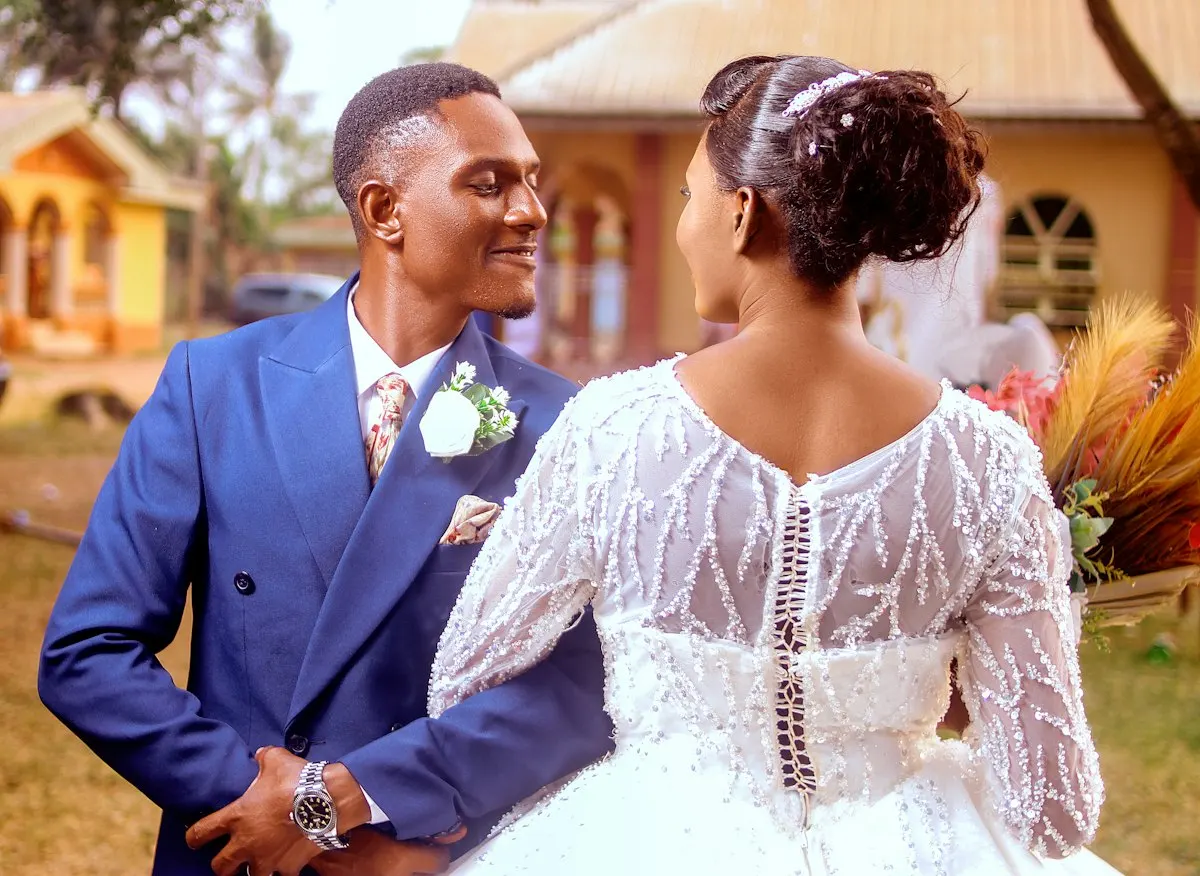
Photo: Sandy Millar on Unsplash.
Do Muslim and traditional marriages have vows?
Not in the Western sense. A nikah is completed by offer and acceptance in front of witnesses, with the bride's guardian involved and the mahr (sadaki) agreed. A traditional marriage is sealed by the families' rites, such as the Igbo bride carrying palm wine to her groom at the igba nkwu. Personal words can come later.
For Muslim couples in Nigeria, the Nikkai and Fatiha cost guide explains what the ceremony involves, and our sadaki guide covers the mahr. If you want to say something personal to each other, the walima or a family dinner is the usual place.
At a traditional marriage, the public "yes" is the ritual itself. In the igba nkwu, the bride searches the crowd, finds her groom and offers him the cup of palm wine; when he drinks, everyone knows. Our traditional wedding checklist walks through each one.
How long should personal wedding vows be?
Aim for about one minute each, which is roughly 120 to 180 words spoken at a normal pace. That's long enough to say something true and short enough that nobody's voice gives out halfway. Agree a rough length with your partner so one of you doesn't speak for four minutes while the other says three lines.
A simple structure that works:
- Something about them. One specific thing you love, not a list.
- A short story. The moment you knew, or the moment that summed them up.
- Two or three promises. Concrete ones beat grand ones. "I'll always pick you up from the airport" beats "I'll give you the world".
- A closing line. Something you'll both remember.
Write it on a card, not your phone. A phone screen lights up your face badly in the photos, and someone will inevitably send you a WhatsApp message mid-vow.
What are some examples of wedding vows for Nigerian couples?
Here are eight short examples, written for this guide. Borrow a line, change the names and details, and make them yours. Swap the faith references in or out to suit your ceremony, and practise them aloud at least three times before the day.
1. Simple and faith-based (either partner)
"[Name], before God, our families and our friends, I take you as my husband. I promise to pray with you and for you, to be honest with you when it's hard, and to choose you again every morning. Whatever this life brings, we'll face it together."
2. Short, for a registry lunch (either partner)
"The registrar made it legal. I'll make it last. I promise to keep laughing with you, to keep listening when I'd rather argue, and to always save you the last piece of chicken."
3. For the groom
"[Name], I knew I was in trouble the day you corrected my grammar in front of my friends and I didn't even mind. I promise to respect you, protect you and stand by you, in Lagos traffic and in hard seasons. Your family is my family now, and mine is yours."
4. For the bride
"[Name], you are the calmest person in every room, including this one. I promise to love you loudly, to tell you the truth gently, and to build a home where our children see what kindness looks like. I'm proud to be your wife."
5. With a word in Yoruba, Igbo or Hausa
"[Name], I've said it in English a thousand times, so let me say it the way my mother would. Mo nifẹ rẹ (Yoruba) / A hụrụ m gị n'anya (Igbo) / Ina sonki (Hausa, to a woman; ina sonka to a man). I love you. I promise to honour you, to honour our families, and to keep choosing you."
6. For couples who've been together a long time
"Ten years ago you bought me suya and I thought it was a date. You said it wasn't. We still argue about that. I promise to keep arguing with you about small things and agreeing with you about the big ones, for the rest of our lives."
7. For a second marriage or blended family
"[Name], you came with a full heart and two wonderful children, and you made room for me. I promise to love all three of you, to be patient as we learn each other's ways, and to make our home a safe place for everyone in it."
8. For a long-distance couple
"We've done video calls across time zones, missed flights and too many goodbyes at the airport. Today is the last goodbye. I promise to be present, to make home wherever you are, and to never take an ordinary evening with you for granted."
A quick note on the language lines in example 5: check the spelling and tone marks with a native speaker in your family. A small mistake in front of the grandparents is the sort of thing people remember fondly, but you'd still rather get it right.

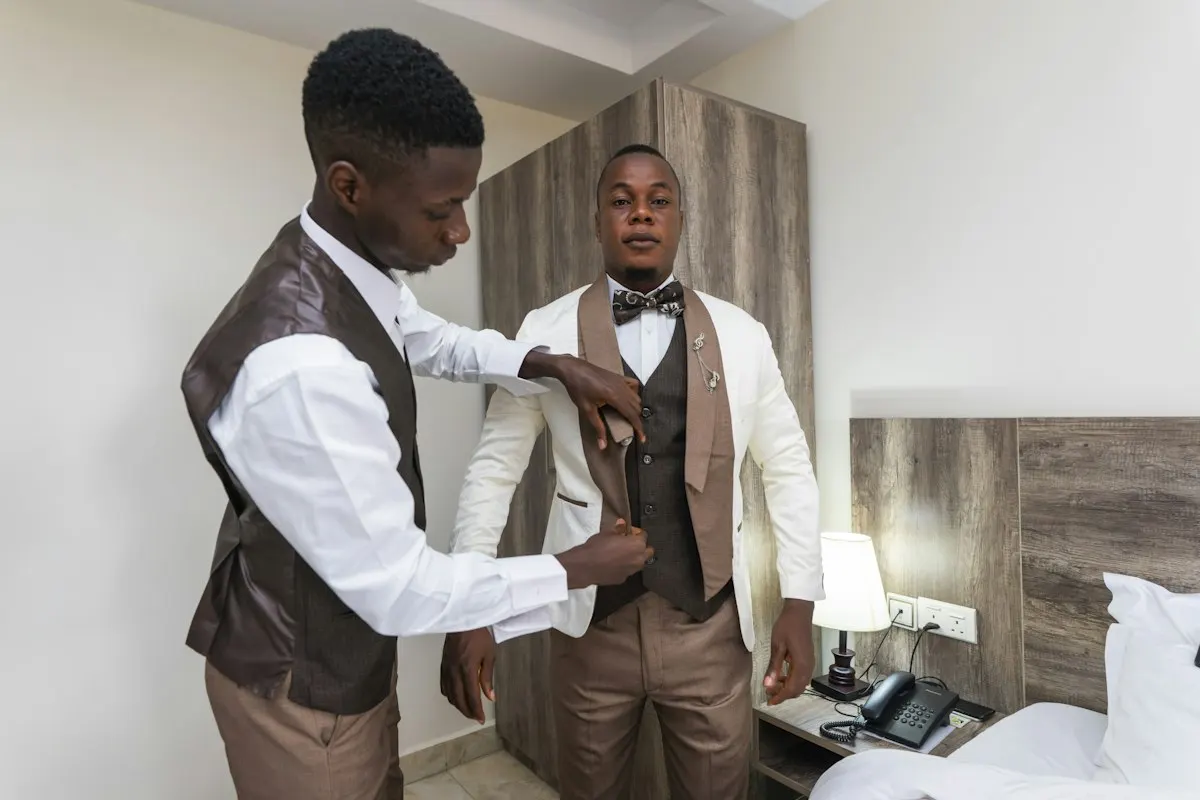
Photo: Alexander Mass on Unsplash.
Frequently asked questions
What do you say at a court wedding in Nigeria?
After the registrar asks if you've come to become husband and wife and explains the law on divorce and bigamy, each of you says: "I call upon all persons here present to witness that I, A.B., do take thee, C.D., to be my lawful wife (or husband)." That wording is set by section 27 of the Marriage Act.
Can we write our own vows for a Nigerian church wedding?
It depends on the church. Catholic and most Anglican services use set vows that you repeat after the minister. Many Pentecostal and independent churches let couples add personal vows alongside them. Ask your pastor early; if the answer is no, say your own vows at the reception.
Are there vows in a Nigerian traditional marriage?
No spoken vows are required. A traditional marriage is sealed by the families' rites, such as the bride offering palm wine to her groom at an Igbo igba nkwu. Couples who want to say personal vows usually do it at the reception or the white wedding.
How long should wedding vows be?
About one minute each, roughly 120 to 180 words. Agree a length with your partner so the vows feel balanced, write them on a card rather than a phone, and practise them aloud a few times so the words come naturally on the day.
Do Muslims exchange vows at a nikah?
Not in the Western sense. A nikah is completed by offer and acceptance before witnesses, with the bride's guardian involved and the mahr agreed. Some couples share personal words at the walima or a family dinner, but nothing beyond the nikah itself is required.
Planning the ceremony? Pick your rings with our ring finger guide, lay out the day with the reception programme template, or browse all planning guides.